
Assistance & Advisory Services for NRIs & Overseas Indians
Assistance & Advisory Services for NRIs & Overseas Indians
As the 26th of January dawns, a wave of pride, nostalgia, and unwavering patriotism sweeps across India. From the majestic parade along Kartavya Path to the vibrant celebrations in every corner of the nation, Republic Day is a powerful reaffirmation of India’s sovereignty, its democratic values, and the spirit of its people. But for the millions of Non-Resident Indians (NRIs) and overseas Indians scattered across the globe, this day carries a unique and profound significance.
While you may be thousands of miles away from the familiar sights and sounds of Republic Day in India, the essence of this day resonates just as strongly within you. It’s a day that transcends geographical boundaries, reminding us of the rich heritage and the foundational principles that bind us all as Indians.
More Than a Date: A Declaration of Identity
Republic Day is not just a public holiday; it’s a declaration. It’s the day India adopted its Constitution in 1950, a document that enshrines justice, liberty, equality, and fraternity for every citizen. For you, living and working in diverse cultures, this day serves as a powerful anchor to your Indian identity. It’s a moment to reflect on the journey of a nation that emerged from colonial rule to establish itself as the world’s largest democracy, a testament to resilience, wisdom, and foresight.
Connecting with Your Roots
From celebrating with your local Indian community to sharing stories of India with your children, Republic Day offers a poignant opportunity to reconnect with your roots. It’s a chance to explain the significance of the national flag, the meaning of the Preamble, and the incredible diversity that thrives within India’s democratic framework. It’s about instilling that sense of belonging and pride in the next generation, ensuring they understand the legacy they inherit.
Your Role in India’s Growth Story
Republic Day is also a reminder of the collective strength of India, a strength that is significantly bolstered by its diaspora. Your contributions, whether through remittances, investments, cultural ambassadorship, or professional excellence, play a vital role in shaping India’s global image and contributing to its ongoing development. Every success you achieve abroad shines a light on India’s potential, showcasing the talent and enterprise that originates from our land.
A Vision for the Future
As India continues its march towards becoming a global leader, building on its economic prowess, technological advancements, and cultural influence, Republic Day serves as an annual pledge. It’s a commitment to uphold the values that make India unique, to strive for a more inclusive and prosperous society, and to continue fostering innovation and progress.
For every NRI and overseas Indian, Republic Day is an invitation to celebrate this grand narrative. It’s a moment to reflect on where we come from, appreciate where we stand, and look forward with hope and enthusiasm to the future of our incredible nation.
**Happy Republic Day! May the spirit of India always shine brightly, no matter where you are.**
For many NRIs and overseas Indians, buying a home back in India is a story of “India Wapsi”—a journey of returning to one’s roots, securing a piece of the homeland, and building a foundation for the future. What was once a purely emotional decision has now transformed into a sophisticated financial strategy.
The scale of investment from the global Indian community has reached unprecedented levels. In the last fiscal year (FY25), NRI investments in Indian real estate were estimated to cross $14 billion to $15 billion.
This influx is part of a broader trend of “financial homecoming.” Total remittances into India hit a record milestone of $135.46 billion in FY25, a 14% increase year-on-year. For the first time, NRIs are contributing nearly 20% of the total real estate investments in the country, with luxury housing and Grade-A commercial spaces being the top choices.
Beyond the emotional pull of having a “home base,” several structural merits make India the preferred investment destination for 2026:
The traditional property-buying experience for NRIs is often marred by a “broker-client” dynamic—a transaction-heavy relationship where the broker’s goal ends at the sale, often leaving the NRI to handle the complexities of maintenance and legalities from thousands of miles away.
We believe in replacing the broker with a partner. Our vision for a concierge-led model focuses on creating authentic, genuine connections rather than just closing deals:
By focusing on the “India Wapsi” experience, we help you build more than just a portfolio; we help you maintain your ties to home with the peace of mind you deserve.
For NRIs around the world, the dream of “India Wapsi”—a return to roots, a connection to heritage, or a strategic investment—often begins with property. It’s more than just bricks and mortar; it’s a piece of home, a tangible link to family, and a stake in India’s booming future. However, the excitement of buying property can quickly turn to anxiety when faced with the realities of managing it from thousands of miles away.
The traditional property journey for NRIs often ends at the transaction. You’ve signed the papers, perhaps even received the keys, but then what? Who handles the leaky faucet? Who finds reliable tenants? Who ensures your property remains a valuable asset, not a nagging worry? This is where the old “broker-client” dynamic falls short, leaving a gaping void between purchase and true peace of mind.
At India Wapsi, we believe your journey shouldn’t end at the sale. We’re redefining the NRI property experience by moving beyond the role of a mere middleman and becoming your trusted partner on the ground. Our mission is to transform property ownership in India from a potential source of stress into a seamless, secure, and genuinely fulfilling experience.
Replacing the Broker: A Partnership Built on Trust
Imagine having a dedicated team in India who acts as your eyes, ears, and hands, ensuring every aspect of your property is managed with the same care you would give it yourself. This isn’t just about finding a property; it’s about fostering an authentic connection that extends long after the papers are signed.
We envision a future where every NRI can own property in India with absolute confidence. Your investment isn’t just a financial asset; it’s a legacy, a connection, and a promise. Let India Wapsi be the bridge that ensures this promise is not only kept but thrives, offering you true peace of mind and an authentic connection to your home country.
Ready to experience property ownership in India, reimagined? Contact India Wapsi today to discover how our concierge services can transform your investment into a truly effortless asset.
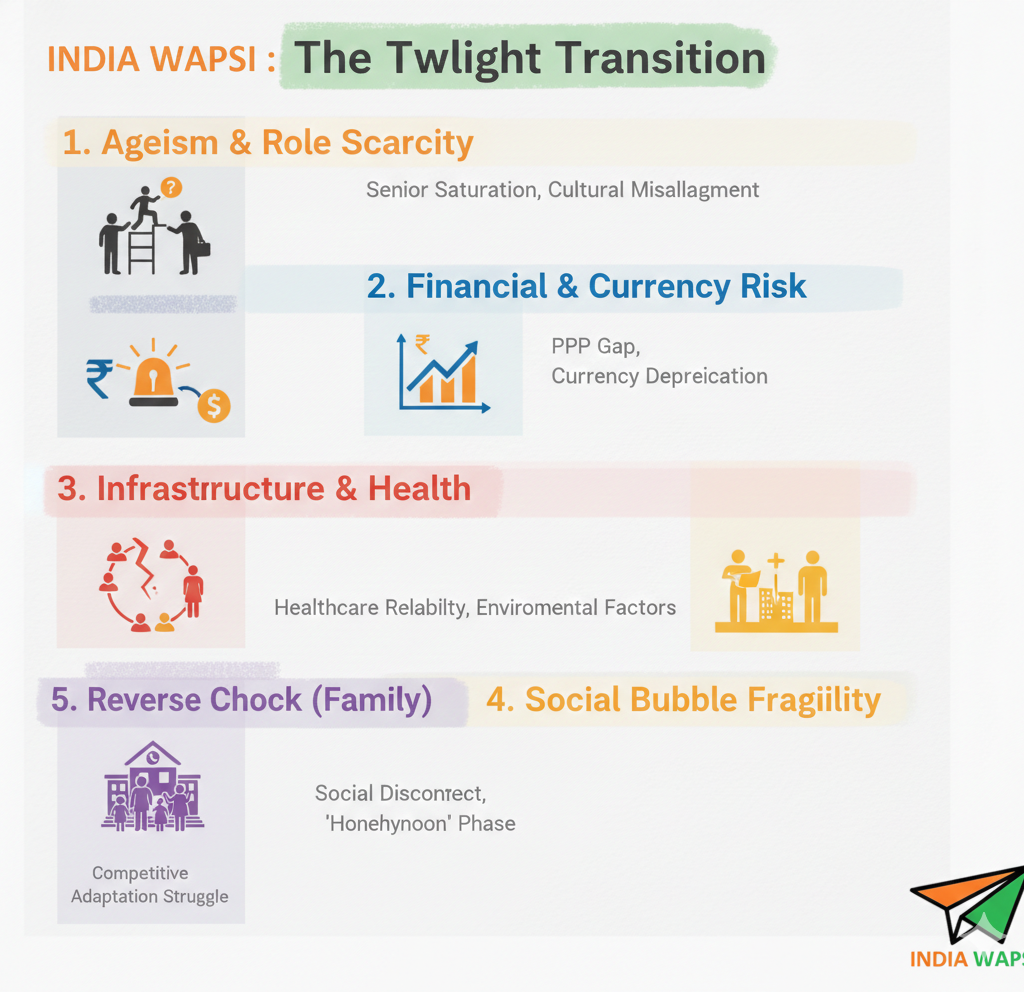
Moving back to India during the “twilight” of a career—often referred to as the “India Wapsi” phase—is a major life transition that balances emotional fulfillment with significant structural risks.
While the “Reverse Brain Drain” is often driven by a desire to be near aging parents or to contribute to the Indian ecosystem, the risks for senior executives are unique.
Unlike the US, where “fractional” leadership or advisory roles for veterans are common, the Indian corporate market can be intensely youth-centric.
This is often the “silent” risk that causes many to return to the US after a few years:
Many returning NRIs find that the India they left 20 years ago no longer exists.
If your children are still dependent or early in their careers, the competitive intensity of the Indian education system and job market can be a massive shock. If they struggle to adapt, it often forces a “second migration” back to the US, which can be financially and emotionally draining.
For many NRIs, the question isn’t if you should return to India, but when and how. The emotional pull of aging parents, cultural roots, and the vibrant energy of a booming economy is strong—but so are the anxieties. From navigating complex tax transitions like RNOR status to finding the right IB schools or managing “reverse culture shock,” the logistics can feel overwhelming.
You don’t have to figure it out alone.
We invite you to join the India Wapsi Discussion Board, a dedicated space where the global Indian community connects to share real-world experiences. Whether you are in the early stages of “Ghar Wapsi” or have already moved back, this forum is your go-to resource.
Discussion Boards URL: www.indiawapsi.com/community/
India is calling, and the transition should be a celebration, not a stress test. Let’s turn your “what-ifs” into a concrete roadmap.
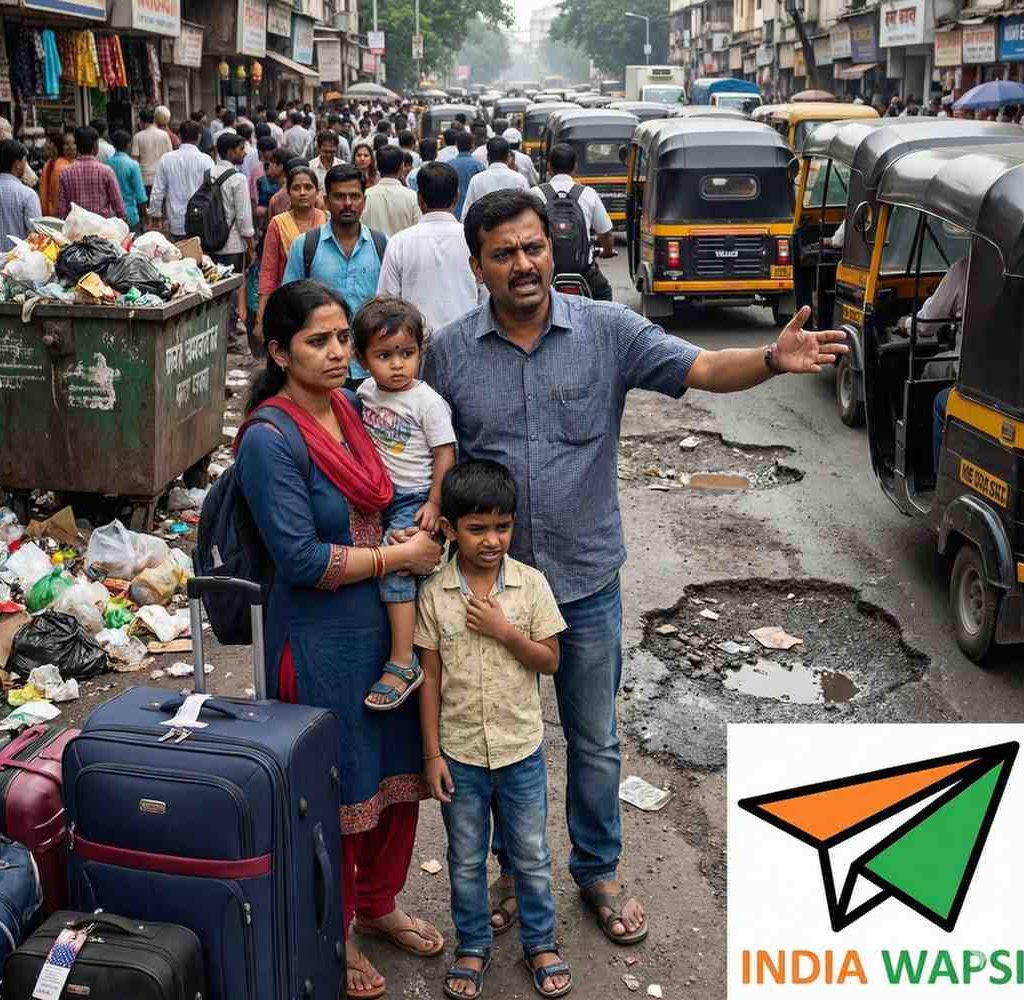
We always said we’d move back “someday.” But when you’ve spent 11 years building a life in the suburbs of New Jersey—buying the house with the backyard, climbing the corporate ladder, and having kids who pledge allegiance to the flag every morning—”someday” feels like a distant abstraction.
Then, reality hit. The H1B extension was denied. Appeals failed. The clock ran out.
In a span of three months, the Sharmas (that’s us) packed a decade of memories into 20 cardboard boxes and boarded a one-way flight to Bengaluru. We weren’t coming back as tourists this time. We were coming back to live. And frankly? We were terrified.
The first week was a blur of family reunions and nostalgic foods. But once the relatives went home and we tried to set up our daily routine, the “Reverse Culture Shock” hit us like a freight train. It wasn’t just different; it felt overwhelmingly chaotic.
1. The Assault on the Senses (Sanitation & Hygiene) We had forgotten the dust. It seemed to coat everything within minutes. But harder to adjust to was the general sanitation. Taking the kids out meant scanning every inch of a restaurant for cleanliness ratings that didn’t exist. We struggled with the lack of clean public restrooms—something we took for granted in the US. Seeing trash piles on street corners or overflowing dumpsters right next to luxury apartments was a jarring visual contradiction we couldn’t explain to our American-born children.
2. The Infrastructure Hurdle In the US, if the GPS said 20 minutes, it took 20 minutes. Here, a 5-kilometer drive could take 45 minutes or two hours depending on the mood of the traffic gods. The potholes weren’t just bumps; they were craters. The sidewalks—if they existed—were often encroached upon by vendors or parked motorcycles, forcing us to walk on the road with our stroller, terrified of the erratic driving.
3. The Behavioral Shift This was perhaps the hardest pill to swallow. We missed the “personal bubble.” In queues at the grocery store, people stood inches from us. If we left a polite gap, someone would cut in. The concept of “right of way” seemed non-existent. The noise levels—honking, construction, loud conversations—felt relentless. We missed the quiet “nod and smile” of our old neighborhood; here, we felt stared at, judged, and strangely, like foreigners in our own motherland.
Three weeks in, I broke down. I felt isolated. My old friends in India couldn’t relate—they thought we were being “snobs.” My friends in the US couldn’t help—they were miles away. We were stuck in limbo, feeling guilty for hating the chaos and resentful that we were forced to return.
That’s when I stumbled upon India Wapsi while doom-scrolling late at night.
I booked a consultation call, expecting generic advice on moving companies or bank accounts. What I got was a lifeline.
The consultant from India Wapsi didn’t just give us a checklist; they gave us validation. They listened as I vented about the traffic and the noise. They didn’t tell me to “get over it.” Instead, they explained the psychology of the return. They broke down the “phases of adjustment” so I knew my anger was normal.
They gave us practical, hyper-local hacks:
The real game-changer, however, was getting added to the India Wapsi WhatsApp Community.
Suddenly, my phone was buzzing not with spam, but with messages from people exactly like us.
It was a safe space. We could complain about the civic infrastructure without being judged as “anti-national,” and we could celebrate the small wins—like getting our Aadhar cards or finding a quiet park—with people who understood the magnitude of those victories.
Are the roads perfect? No. do people still cut lines? Yes.
But we are no longer drowning. Thanks to the guidance from the consultation call and the daily support of the WhatsApp group, we’ve learned to navigate the chaos. We’ve found our pockets of peace. We’ve learned to laugh at the traffic rather than cry.
If you are an NRI facing the daunting prospect of returning—whether by choice or by force—don’t do it alone. The logistics are manageable, but the emotional transition requires a village. India Wapsi became that village for us.

Teaching children about Indian culture while living abroad is a journey of creating a “mini-India” within your home. It’s less about formal lessons and more about weaving traditions into the fabric of their daily lives.
Here are some practical and creative ways to bridge that gap:
Language is the strongest bridge to any culture.
Don’t just observe festivals; make them a production.
Grandparents are the most authentic link to your family’s history.
Nothing replaces the real thing.

For years, my New Year’s Eve has been a montage of brightly lit cityscapes abroad, muted celebrations, and a poignant phone call to India as the clock struck midnight there. While I’ve loved the life I’ve built, a part of me always missed the vibrant, joyous chaos of an Indian New Year – especially the unique energy of Kolkata, my hometown.
This year, however, I decided to do something different. I decided to bring the glamour of a Kolkata New Year to my family, without actually being there myself. And the secret ingredient? India Wapsi.
My parents, bless their hearts, are not ones for grand gestures. Their idea of a perfect New Year’s Eve is a quiet dinner at home, maybe watching a Bengali movie. But after years of them selflessly supporting my journey abroad, I wanted to give them something truly special, something they wouldn’t even dream of arranging for themselves.
The idea was simple: a surprise New Year’s Eve dinner and celebration for my parents and our closest relatives at a posh hotel in Kolkata. The challenge? Coordinating everything from a different time zone, ensuring it was a genuine surprise, and handling all the intricate details of an Indian family gathering.
I stumbled upon India Wapsi while looking for services that could help NRIs with tasks back home. Their premise of bridging the gap for those of us living abroad immediately resonated. After a quick consultation, I knew I had found my partners in crime.
Their team became my eyes and ears on the ground in Kolkata. From understanding my vision to suggesting the perfect hotel with a view of the city’s festive lights, they handled it all.
As the New Year approached in Kolkata, I was glued to my phone, thousands of miles away. India Wapsi had arranged for one of my cousins to discreetly video call me as the family arrived at the hotel.
Seeing my parents’ faces light up with surprise and then sheer joy was worth every penny, every late-night planning call. My mother, in a beautiful new saree, kept asking, “How did you manage all this?” My father, usually stoic, had a wide, happy grin as he looked around the beautifully decorated banquet hall.
I saw them laughing, dancing (yes, even my father attempted a step or two!), and celebrating with our family, all thanks to the meticulous planning by India Wapsi. It felt as if I was right there with them, sharing in the warmth and festivity.
This New Year wasn’t just a celebration; it was a revelation. It showed me that even when oceans separate us, we can still create meaningful, memorable experiences for our loved ones back home. India Wapsi didn’t just plan a party; they helped me send a piece of my heart across continents, creating a new, cherished family memory.
To my family in Kolkata, Happy New Year! And to India Wapsi, thank you for making it possible. Here’s to many more years of celebrating together, even when we’re apart.
To arrange parties or events for your family back home, please email contact@indiawapsi.com
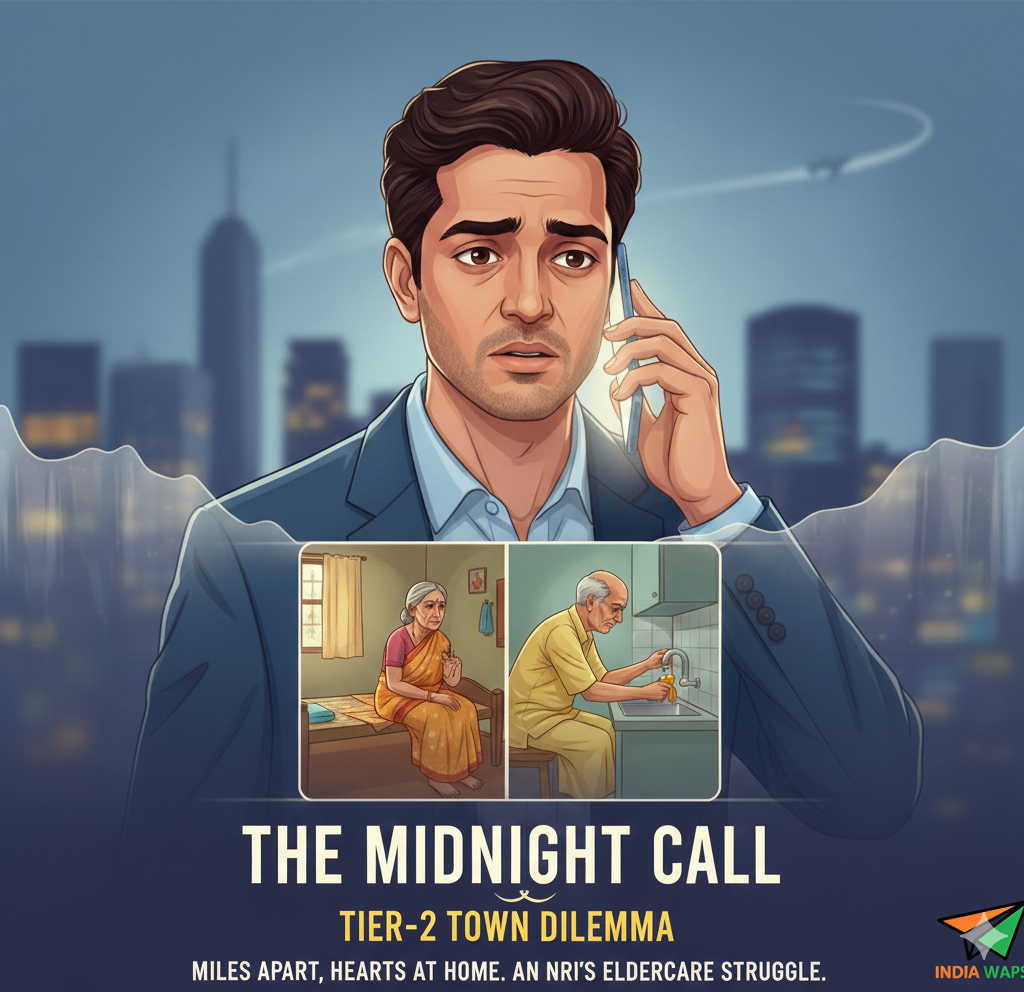
For many of us living abroad, the “New Year” isn’t just a time for champagne toasts and fireworks. It’s often a time of heightened anxiety. As we look at the calendar, we realize another year has passed—which means our parents back home in India are another year older.
But for the NRI whose parents live in a Tier-2 town, the challenge isn’t just emotional. It’s logistical.
If my parents were in Bangalore, Mumbai, or Delhi, I could solve most problems with an app. Need a specialized geriatric nurse? There’s a startup for that. Need a premium meal service or a 24/7 emergency response team? It’s a click away.
But in a Tier-2 town, the “Digital India” revolution feels a little thinner when it comes to eldercare. Here, the infrastructure still relies on the “Good Neighbor” system—a system that is slowly eroding as younger generations move away for work.
Living in a smaller city brings a specific set of worries that keep me up at 3:00 AM:
There is a specific kind of “NRI Guilt” that comes with every missed anniversary or every time a parent sounds “a little tired” over WhatsApp. In a Tier-2 town, where home-delivery and home-healthcare haven’t quite matured, that guilt is amplified. You feel like you’ve left them in a gap between the traditional joint-family support of the past and the modern professional services of the future.
So, how do we bridge this gap from thousands of miles away?
If you spent your New Year’s Day checking in on a parent in a quiet town in Punjab, Kerala, or Bihar, knowing you can’t get there in under 24 hours—I see you. It is a heavy mantle to carry, balancing a career abroad with a heart that is constantly checking the pulse of a home far away.
As we navigate 2026, let’s pledge to share our resources and tips for managing eldercare in the “Real India”—the towns that don’t always make the tech headlines, but hold the people who matter most to us.