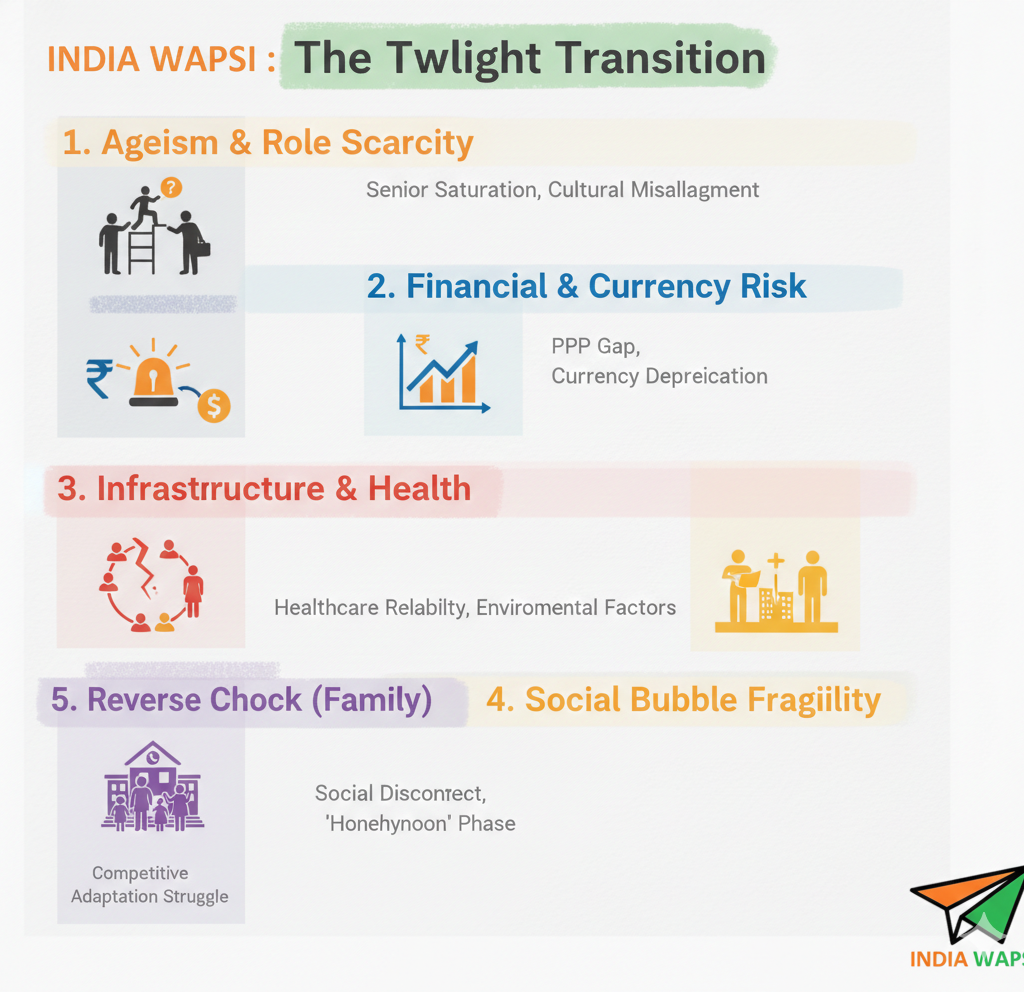
Moving back to India during the “twilight” of a career—often referred to as the “India Wapsi” phase—is a major life transition that balances emotional fulfillment with significant structural risks.
While the “Reverse Brain Drain” is often driven by a desire to be near aging parents or to contribute to the Indian ecosystem, the risks for senior executives are unique.
1. The “Ageism” and Role Scarcity Risk
Unlike the US, where “fractional” leadership or advisory roles for veterans are common, the Indian corporate market can be intensely youth-centric.
- Senior Saturation: There is often a surplus of senior talent in India and a limited number of “C-suite” or “Business Head” roles that offer the same autonomy you may have enjoyed abroad.
- Cultural Misalignment: You might find that Indian companies—even large ones—sometimes operate with a more hierarchical, promoter-driven style that can clash with the democratic, process-oriented leadership typical of the West.
2. Financial and Currency Risk
- The PPP Gap: While the cost of living in India is lower, the “quality of life” cost (gated communities, international schools, private healthcare) is rising rapidly.
- Currency Depreciation: If your retirement nest egg remains in USD, you face the risk of fluctuating exchange rates. Conversely, if you move your capital to India, the historical trend of the Rupee depreciating against the Dollar could erode your global purchasing power over time.
3. Infrastructure and Health Regression
This is often the “silent” risk that causes many to return to the US after a few years:
- Healthcare Quality vs. Reliability: While India has world-class private hospitals, the emergency response systems (ambulances, trauma care) and the administrative “friction” of insurance can be a shock.
- Environmental Factors: Air quality in major hubs like Delhi/NCR or Bangalore and the daily friction of traffic can significantly impact your physical and mental well-being as you age.
4. The “Social Bubble” Fragility
Many returning NRIs find that the India they left 20 years ago no longer exists.
- Social Disconnect: Friends and extended family have moved on, and building a new social circle from scratch at 55+ can be lonelier than expected.
- The “Honeymoon” Phase: The first six months often feel like a vacation; the risk is the subsequent realization that “visiting India” and “living in India” are two entirely different operating systems.
5. Reverse Culture Shock for Family
If your children are still dependent or early in their careers, the competitive intensity of the Indian education system and job market can be a massive shock. If they struggle to adapt, it often forces a “second migration” back to the US, which can be financially and emotionally draining.