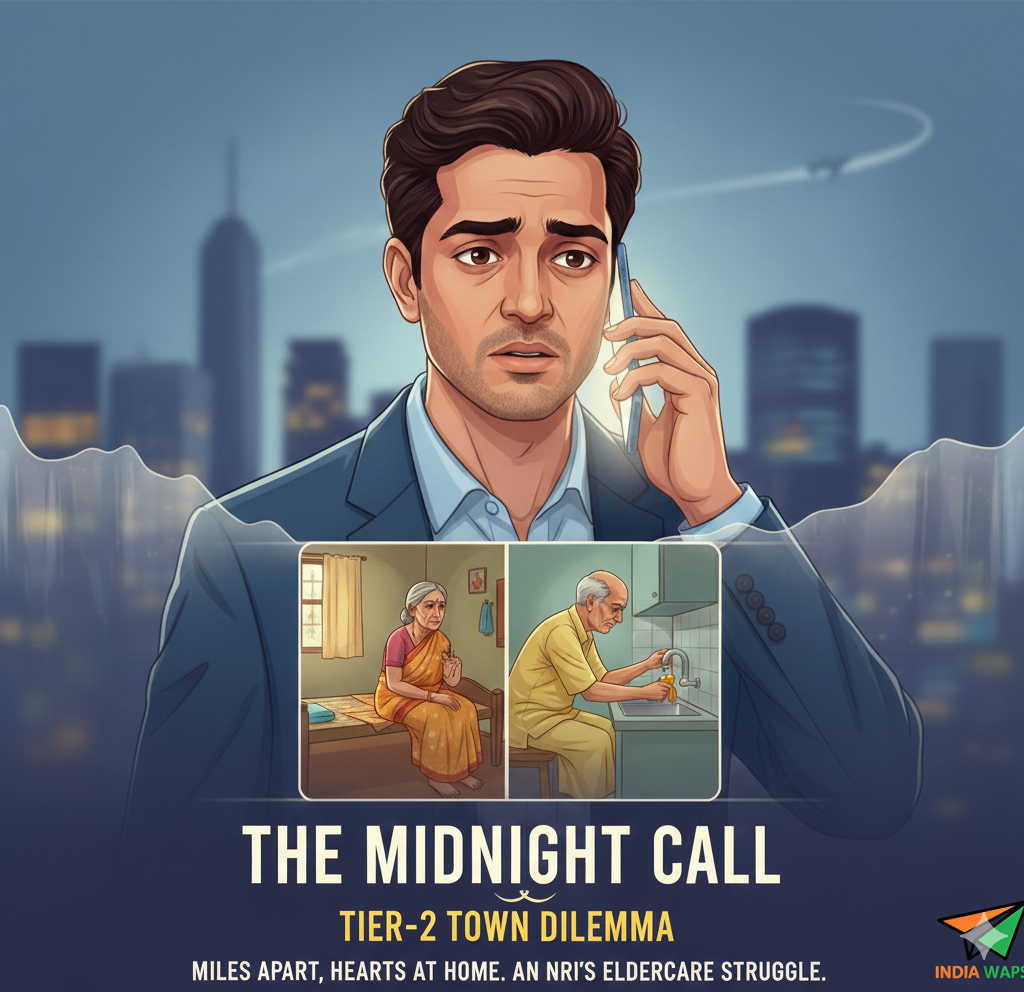
The Midnight Call and the Tier-2 Dilemma: An NRI’s Silent Struggle
For many of us living abroad, the “New Year” isn’t just a time for champagne toasts and fireworks. It’s often a time of heightened anxiety. As we look at the calendar, we realize another year has passed—which means our parents back home in India are another year older.
But for the NRI whose parents live in a Tier-2 town, the challenge isn’t just emotional. It’s logistical.
Beyond the “Metro” Safety Net
If my parents were in Bangalore, Mumbai, or Delhi, I could solve most problems with an app. Need a specialized geriatric nurse? There’s a startup for that. Need a premium meal service or a 24/7 emergency response team? It’s a click away.
But in a Tier-2 town, the “Digital India” revolution feels a little thinner when it comes to eldercare. Here, the infrastructure still relies on the “Good Neighbor” system—a system that is slowly eroding as younger generations move away for work.
The Invisible Hurdles
Living in a smaller city brings a specific set of worries that keep me up at 3:00 AM:
- The “Logistics” Gap: There are no fancy assisted-living facilities. If the geyser breaks or the medicine stock runs low, there isn’t a dedicated concierge service. It falls on the aging parents to manage, or on us to coordinate via a flurry of international calls.
- The Medical Maze: While Tier-2 towns have good doctors, they often lack integrated emergency systems. There’s no “one number to call” that I can trust will handle the ambulance, the hospital admission, and the insurance paperwork while I’m stuck behind a 14-hour flight.
- The Social Vacuum: In smaller towns, “eldercare” is still largely seen as a family responsibility. Hiring outside help is often met with local stigma (“Why aren’t their children looking after them?”), making parents reluctant to accept professional aid even if it’s available.
The Guilt of the Distance
There is a specific kind of “NRI Guilt” that comes with every missed anniversary or every time a parent sounds “a little tired” over WhatsApp. In a Tier-2 town, where home-delivery and home-healthcare haven’t quite matured, that guilt is amplified. You feel like you’ve left them in a gap between the traditional joint-family support of the past and the modern professional services of the future.
Finding a Way Forward
So, how do we bridge this gap from thousands of miles away?
- Building a “Human” Network: Since we can’t rely on apps, we rely on people. This year, I’m focusing on strengthening ties with the local pharmacist, the trusted auto-driver, and the neighbor’s son. In Tier-2 India, relationships are the infrastructure.
- Tech-Enablement: Installing smart cameras (with consent) and smart locks isn’t about surveillance; it’s about peace of mind.
- The Honest Conversation: It’s time to talk to our parents about professional help before it becomes a crisis. We have to normalize the idea that hiring a helper isn’t a failure of the child, but a tool for their independence.
To My Fellow NRIs
If you spent your New Year’s Day checking in on a parent in a quiet town in Punjab, Kerala, or Bihar, knowing you can’t get there in under 24 hours—I see you. It is a heavy mantle to carry, balancing a career abroad with a heart that is constantly checking the pulse of a home far away.
As we navigate 2026, let’s pledge to share our resources and tips for managing eldercare in the “Real India”—the towns that don’t always make the tech headlines, but hold the people who matter most to us.