We always said we’d move back “someday.” But when you’ve spent 11 years building a life in the suburbs of New Jersey—buying the house with the backyard, climbing the corporate ladder, and having kids who pledge allegiance to the flag every morning—”someday” feels like a distant abstraction.
Then, reality hit. The H1B extension was denied. Appeals failed. The clock ran out.
In a span of three months, the Sharmas (that’s us) packed a decade of memories into 20 cardboard boxes and boarded a one-way flight to Bengaluru. We weren’t coming back as tourists this time. We were coming back to live. And frankly? We were terrified.
The Honeymoon Phase That Wasn’t
The first week was a blur of family reunions and nostalgic foods. But once the relatives went home and we tried to set up our daily routine, the “Reverse Culture Shock” hit us like a freight train. It wasn’t just different; it felt overwhelmingly chaotic.
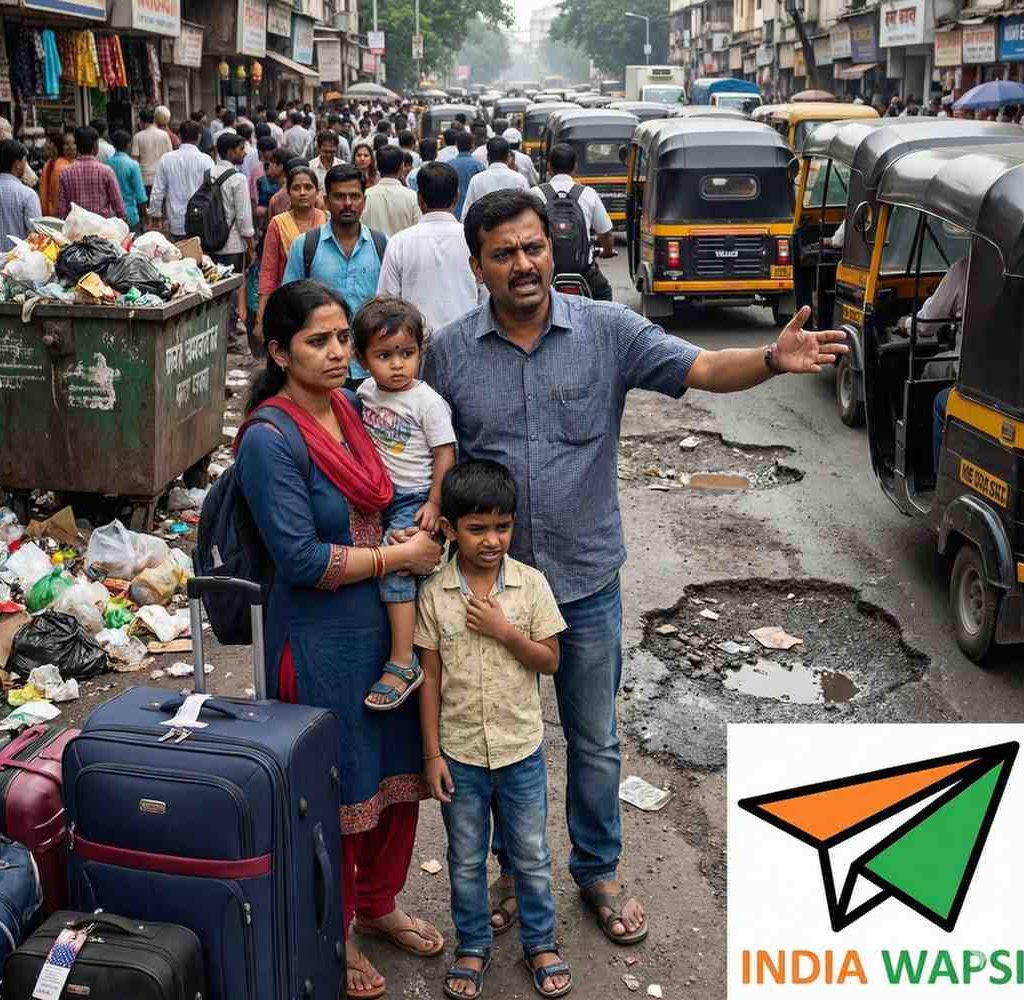
1. The Assault on the Senses (Sanitation & Hygiene) We had forgotten the dust. It seemed to coat everything within minutes. But harder to adjust to was the general sanitation. Taking the kids out meant scanning every inch of a restaurant for cleanliness ratings that didn’t exist. We struggled with the lack of clean public restrooms—something we took for granted in the US. Seeing trash piles on street corners or overflowing dumpsters right next to luxury apartments was a jarring visual contradiction we couldn’t explain to our American-born children.
2. The Infrastructure Hurdle In the US, if the GPS said 20 minutes, it took 20 minutes. Here, a 5-kilometer drive could take 45 minutes or two hours depending on the mood of the traffic gods. The potholes weren’t just bumps; they were craters. The sidewalks—if they existed—were often encroached upon by vendors or parked motorcycles, forcing us to walk on the road with our stroller, terrified of the erratic driving.
3. The Behavioral Shift This was perhaps the hardest pill to swallow. We missed the “personal bubble.” In queues at the grocery store, people stood inches from us. If we left a polite gap, someone would cut in. The concept of “right of way” seemed non-existent. The noise levels—honking, construction, loud conversations—felt relentless. We missed the quiet “nod and smile” of our old neighborhood; here, we felt stared at, judged, and strangely, like foreigners in our own motherland.
The Breaking Point
Three weeks in, I broke down. I felt isolated. My old friends in India couldn’t relate—they thought we were being “snobs.” My friends in the US couldn’t help—they were miles away. We were stuck in limbo, feeling guilty for hating the chaos and resentful that we were forced to return.
That’s when I stumbled upon India Wapsi while doom-scrolling late at night.
The Turning Point: The Consultation Call
I booked a consultation call, expecting generic advice on moving companies or bank accounts. What I got was a lifeline.
The consultant from India Wapsi didn’t just give us a checklist; they gave us validation. They listened as I vented about the traffic and the noise. They didn’t tell me to “get over it.” Instead, they explained the psychology of the return. They broke down the “phases of adjustment” so I knew my anger was normal.
They gave us practical, hyper-local hacks:
- Which neighborhoods truly offer the “walkable” lifestyle we missed.
- How to vet schools that understand the transition for US-born kids.
- Specific services for deep cleaning and water filtration that eased our hygiene anxieties.
Finding Our Tribe: The WhatsApp Community
The real game-changer, however, was getting added to the India Wapsi WhatsApp Community.
Suddenly, my phone was buzzing not with spam, but with messages from people exactly like us.
- “Does anyone know a pediatrician who doesn’t over-prescribe antibiotics?”
- “Venting post: Just got cut off in traffic 5 times. Need moral support!”
- “Found a store that sells authentic bagels in Indiranagar!”
It was a safe space. We could complain about the civic infrastructure without being judged as “anti-national,” and we could celebrate the small wins—like getting our Aadhar cards or finding a quiet park—with people who understood the magnitude of those victories.
6 Months Later
Are the roads perfect? No. do people still cut lines? Yes.
But we are no longer drowning. Thanks to the guidance from the consultation call and the daily support of the WhatsApp group, we’ve learned to navigate the chaos. We’ve found our pockets of peace. We’ve learned to laugh at the traffic rather than cry.
If you are an NRI facing the daunting prospect of returning—whether by choice or by force—don’t do it alone. The logistics are manageable, but the emotional transition requires a village. India Wapsi became that village for us.